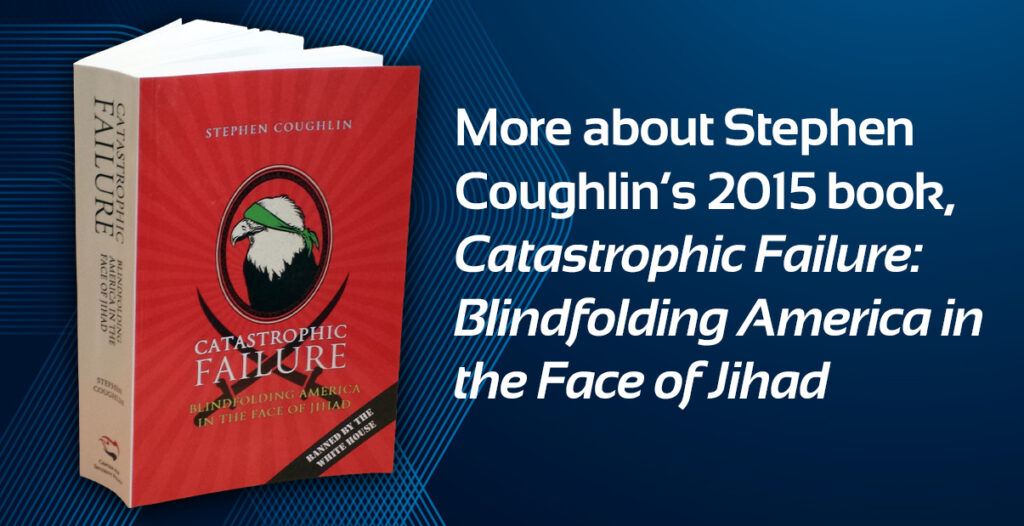

In this important excerpt from Stephen Coughlin’s 2015 book Catastrophic Failure: Blindfolding America in the Face of Jihad, the former Pentagon intelligence analyst and leading expert on Islamic law exposes how the Muslim Brotherhood and associated Islamic Movement groups have systematically penetrated Western interfaith communities. His warning back then is once again prescient and relevant to the present day.
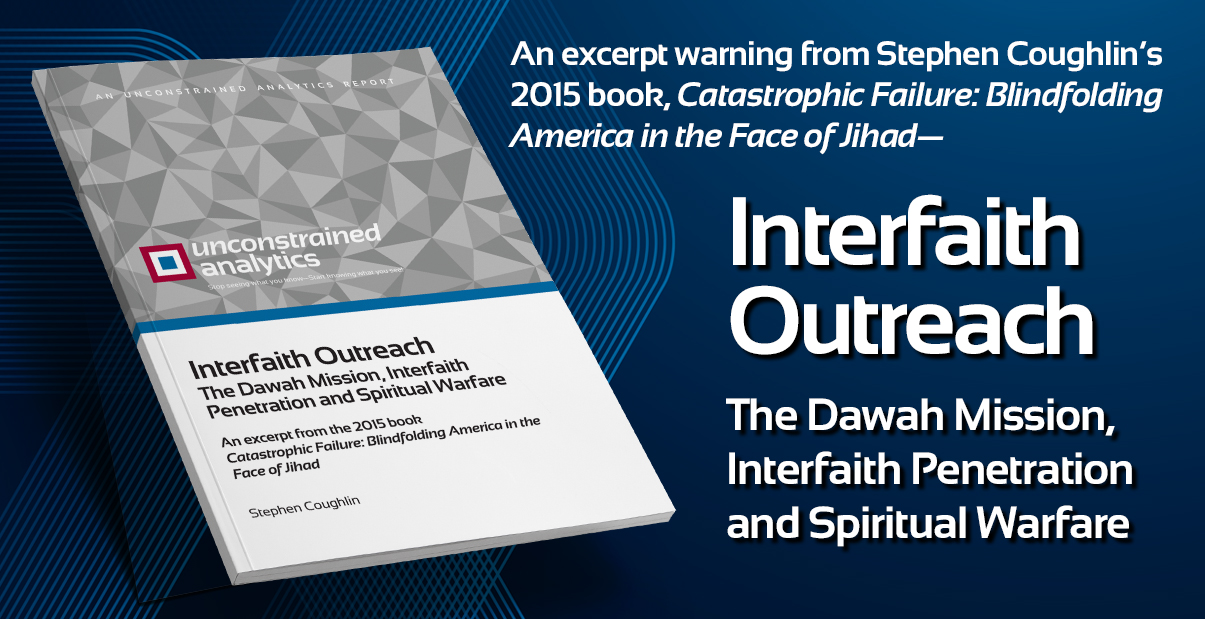
READ: Interfaith Outreach: The Dawah Mission, Interfaith Penetration and Spiritual Warfare (pdf)
Coughlin demonstrates that what is often presented as benign “bridge-building” and peaceful dialogue is, in reality, a sophisticated dawah (Islamic outreach/preparation) operation aligned with the Brotherhood’s strategic goal of “eliminating and destroying Western civilization from within” — by our own hands, as stated in their own 1991 Explanatory Memorandum (entered into evidence in federal court).
KEY INSIGHTS FROM THE EXCERPT
— Dawah is not mere proselytizing. It functions as a preparatory phase of jihad, including spiritual warfare aimed at dislocating faith, undermining will, and creating conditions for greater influence and eventual submission (as explained by Pakistani Brigadier S.K. Malik in The Quranic Concept of War).
— The International Institute of Islamic Thought (IIIT) — a recognized Muslim Brotherhood entity dedicated to the “Islamization of knowledge” — published Interfaith Dialogue: A Guide for Muslims. This guide openly discusses tactics for engaging churches, synagogues, and religious leaders while masking deeper objectives rooted in shariah and Brotherhood doctrine (e.g., Sayyid Qutb’s concepts of bridge-building and progressive revelation).
— Brotherhood-linked groups like ISNA, CAIR, and others participate in interfaith efforts while maintaining dual messaging: one for non-Muslims (emphasizing peace and common ground) and another for Muslims (advancing dawah and civilization-jihad).
— Coughlin highlights how interfaith “rules” — such as mutual trust, avoiding “preconditions,” not “misusing scripture,” and letting each side define its own religion — can be exploited to suppress critical analysis, enforce self-censorship, and subordinate participants’ own faiths. This leads to a dislocation of faith among Christian, Jewish, and other leaders, who may end up silencing their own communities or defending narratives that contradict core doctrines.
— Examples include pressure on speakers sharing testimony of Christian persecution in Muslim-majority countries, university programs like the Olive Tree Initiative that undermine affinity for Israel, and high-level engagements (e.g., Vatican events) where Quranic recitations hostile to Jews and Christians went unchallenged or were downplayed.
— Coughlin contrasts surface-level interfaith claims with authoritative Islamic sources like Reliance of the Traveller (certified by IIIT-linked scholars), Sahih al-Bukhari, tafsirs (e.g., Ibn Kathir), and works by Qutb and Qaradawi. These sources affirm doctrines on jihad, truces (not permanent treaties), treatment of non-Muslims (including jizya and dhimmitude), and the ultimate goal of Islamic supremacy — directly contradicting assertions that “authentic Islam and the proper reading of the Koran are opposed to every form of violence” (e.g., Evangelii Gaudium Paragraph 253).
The analysis applies the “24/25 Rule”: when Brotherhood materials allow competing interpretations, adopt the one consistent with known shariah and organizational doctrine.
THE CORE CONCLUSION
Interfaith outreach involving known Brotherhood entities is not neutral dialogue. It serves as a vector for spiritual subversion, eroding the confidence and doctrinal fidelity of non-Muslim religious leaders and communities. This aligns with the preparation stage of jihad described in Islamic warfare doctrine: destroy the enemy’s will and faith before more kinetic phases.
Coughlin warns that shepherds (clergy and leaders) who prioritize interfaith pledges over fidelity to their own traditions risk feeding their flocks to wolves — all while calling it virtuous. The result is a self-imposed blindness that weakens civil society, national security, and the very faiths being “dialogued.”
This is not about hating individuals or generalizing; it is a call for due diligence, intellectual honesty, and discernment based on the actors’ own stated doctrines, strategies, and historical patterns.
READ: Interfaith Outreach: The Dawah Mission, Interfaith Penetration and Spiritual Warfare (pdf)
An excerpt from the 2015 book Catastrophic Failure: Blindfolding America in the Face of Jihad